Study guide
How to read buoys
Buoys are the road signs of the water. Color, shape and number each tell you something, and together they show you the safe side.
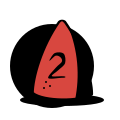
Red right returning
Heading in from seaward, keep red marks to starboard and green marks to port. Heading out, it reverses. The official idea behind this is the conventional direction of buoyage: normally the direction you enter channels from seaward and go toward the head of navigation. Where there’s no route from seaward, it generally follows a clockwise direction around land masses, and the chart settles any doubt (33 CFR 62.21).
Lateral marks
| Mark | Color | Buoy shape | Beacon daymark | Numbers | Pass it |
|---|---|---|---|---|---|
| Starboard hand | Red | Nun or pillar | Triangle | Even | Right side, returning |
| Port hand | Green | Can or pillar | Square | Odd | Left side, returning |
Preferred channel marks have red and green horizontal bands and show a junction. The top band gives the preferred channel: red on top means treat it as a red mark, green on top as a green mark (33 CFR 62.25(c)).
The marks that aren't lateral
| Mark | Looks like | Means |
|---|---|---|
| Safe water | Red and white vertical stripes. Spherical, or a red spherical topmark | Navigable water all around, often a fairway, midchannel or the seaward end of a channel (62.27) |
| Isolated danger | Black with one or more broad red bands, two black spheres on top | A danger you can pass on all sides. Don’t approach closely without special caution (62.29) |
| Special | Solid yellow | A special area or feature, such as an anchorage, cable or pipeline area, shown in charts or publications (62.31) |
| Information and regulatory | Orange shapes on white | Open diamond for danger, crossed diamond for keep out, circle for restrictions, square for directions (62.33) |
Don't trust a buoy alone
Buoys move. They swing within a watch circle on their moorings, and storms or collisions can shift or sink them. Charted positions are approximate. The regulations tell mariners not to rely on buoys alone for position, and to use bearings, soundings and other methods as well (33 CFR 62.23). Don’t pass close aboard either: a yawing buoy, its mooring, or what it marks can all be a hazard.
Common questions
What does red right returning mean?
Coming in from seaward in U.S. waters, keep red marks on your starboard side. Red starboard-hand marks show the right side of a channel in the conventional direction of buoyage (33 CFR 62.25).
What is the difference between a nun and a can buoy?
A nun buoy has a tapered, conical shape and is red. A can buoy is cylindrical and green (33 CFR 62.23, 62.25).
Are the numbers on buoys even or odd?
Solid red aids carry even numbers and solid green aids carry odd numbers, and the numbers increase in the conventional direction of buoyage (33 CFR 62.43).
Is it the same everywhere in the world?
No. U.S. navigable waters follow IALA Region B. Region A reverses the colors: port hand marks are red and starboard hand marks are green, while shapes mean the same (33 CFR 62.21, 62.25).
Practice it
Aids to navigation sit in the free Navigation General practice test. For something lighter, Harbor Run is a free boat game that teaches buoys and red right returning to kids and grown-ups.
Keep your marks straight
Helm covers aids to navigation in its Navigation General module, with the rule shown on every answer.
Start freeKeep studying
- Free OUPV practice testReal sample questions, each with its rule. No sign-up.
- Sound signalsEvery horn, bell and fog signal, with audio and citations.
- Lights and shapesWhat each vessel shows at night and by day.
- What the exam coversThe modules, and what to confirm in your letter.
- Six-pack licenseWho needs one and what the regulations ask for.
- Rules of the roadWho gives way, and how Inland differs.
Sources
- 33 CFR 62.21, general
- 33 CFR 62.23, beacons and buoys
- 33 CFR 62.25, lateral marks
- 33 CFR 62.27, safe water marks
- 33 CFR 62.29, isolated danger marks
- 33 CFR 62.31, special marks
- 33 CFR 62.33, information and regulatory marks
- 33 CFR 62.43, numbers and letters
Helm is an independent study aid, not affiliated with or endorsed by the U.S. Coast Guard or the National Maritime Center. This page is for study, not navigation guidance or legal advice. Check the current rules before you rely on anything here.